This is why today’s entry is so short.
Month: April 2008
Categories
Forgo or Forego?
I had what the Spanish call a “lapsus” today (no, not a lapsus freudiano) and completely forgot how to spell a certain word.
I was writing an e-mail to my grandmother, meaning to tell her that I would gladly give up hypothetical thing A for hypothetical thing B. Though I chose the right word, I could not remember how to spell it:
I’m happy to forgo the trip…?
I’m happy to forego the trip…?
Even though it’s my job to correct other people’s English mistakes, I still get uncertain when I write. I’ve said before that the one word I’m always unsure of is misspelling itself—are there two esses or three? In the case above, I didn’t know the etymology of the word. Because I did not know what that first fore was, um, for, I could not be sure of how to spell it. Spellcheck doesn’t help with this one: both “forgo” and “forego” are real English words. But only one means to go without, as I meant to say in my letter. The trouble is that in English you can understand the meaning of a word without explicit knowledge of its component parts, just as in German.
Strangely enough, I’m completely sure how to spell a similar word, one in which the prefix is much more obvious: the foregoing, or what went before. Forethought, forehead, forecast…you can see that Old English fore- hard at work to change the meaning of these words to something primary, something first.
But what about forever, forlorn, forsaken? What’s that for- doing in these words? More importantly, what exactly does it mean? I decided to go with dictionary.com today, a service which borrows heavily from the Random House Unabridged Dictionary:
for-
a prefix meaning “away,” “off,” “to the uttermost,” “extremely,” “wrongly,” or imparting a negative or privative force, occurring in verbs and nouns formed from verbs of Old or Middle English origin, many of which are now obsolete or archaic: forbid; forbear; forswear; forbearance.
[Origin: ME, OE; cf. G ver-, Gk peri-, L per-]
Not exactly a mnemonic, is it? This is tricky stuff: if you Ask Oxford about forego, the next web page you see will offer two links: one for forego and one for forgo. Maybe I’m not the only one who’s had trouble making the distinction.
But no more! From now, as long as I remember that both words exist as legitimate spellings in the English language, I’ve got a foolproof way to tell which one means to go without:
process of elimination.
Occam’s razor. Were you expecting the OED?
Fore goes with before. Which means that forego implies something preceding: something that goes before.
I think we can forgo any further explanation. Don’t you?
In honor of my Chinese readers, please enjoy this link to an astonishing article in this week’s New Yorker on English language learning, the Li Yang way:
China today is divided by class, opportunity, and power, but one of its few unifying beliefs—something shared by waiters, politicians, intellectuals, tycoons—is the power of English. […] Li’s cosmology ties the ability to speak English to personal strength, and personal strength to national power. It’s a combination that produces intense, sometimes desperate adoration. A student named Feng Tao told me that on one occasion, realizing that he had enough cash for tuition to an out-of-town Li lecture but not enough for train fare, “I went and sold blood.”
via Language Log and Dick & Garlick
Categories
Patron Saint of Books?
Today is World Book (and Copyright) Day, as designated by UNESCO in 1995. It’s also St. George’s Day in Great Britain, a celebration of Englishness in the name of the saint who slew the dragon.
These holidays may sound disparate, but each actually depends upon the other.
Why April 23?
We get the importance of this date from Catalonia, an autonomous region in northeastern Spain with its own language. The Catalans have been celebrating St. George’s Day as la diada de Sant Jordi since at least the 15th century with the giving of roses to represent the tradition of “courtly love.” The Catalan government has a good explanation of how the book first got involved:
In 1926 Spain established April 23rd as the ‘Dia del Llibre’ to commemorate the death of Cervantes, imitating England, where the same day was also celebrated because it coincided with the date of the death of Shakespeare. The celebration quickly became popular in Barcelona and spread to the rest of Catalonia, but the original idea lost importance as it coincided with the day of the Patron Saint. However, while the festival was celebrated very little and even disappeared in some areas, in Catalonia it has become one of the most celebrated festivals, and at the same time, it has promoted and extended the sale of books in Catalan.
That last sentence is very true: a large percentage of yearly book sales in Catalonia take place on this date (one site puts the number at “over half”).
Get Out There and Read!
Sant Jordi is a day to enjoy the spring, to enjoy love and life by buying books and roses for those most special to you. I have celebrated Sant Jordi several times in Barcelona and it’s like a citywide Valentine’s Day, more inclusive than our Anglo-Saxon holiday of cards and chocolate. The Catalans ascribe meaning to the color of the rose, just as the English did in the Victorian era, so that the flowers can represent many forms of love: yellow for friendship, red for romance, and more.
World Book Day takes some of that spirit beyond the Spanish border. While Catalan women spend the day today searching for the perfect book to buy for the men they love, UNESCO has ensured that we each take at least a moment to think about literature today.
When you do, dear reader, I hope you’ll remember us translators, too: the life behind the books.
Happy reading! Happy spring!
Today I’m making an exception to the usual anglo-centrism of my blog, for a very good reason:
The World Atlas of Language Structures is now online.
Think about it. Over 2,500 languages with over 6,500 references, and all of them treated equally. Thanks to the Max Planck Digital Library and the Max Planck Institute for Evolutionary Anthropology, both in Germany, you can browse through as many languages as you like for free.
Here’s a taste of what you’ll find at http://wals.info:
number of consonants (from 6 to 122), presence of rare sounds like ö and ü, tone systems, gender categories, plural formation, number of cases, verbal future and past forms, imperatives, word order, passives, numerals, colour terms, writing systems, and more
I predict that linguaphiles everywhere will be jumping on this one. Paging languagehat!
The full press release is here.
When we last left off, we had established that orientated/disorientated is an acceptable usage in British English, while in American English it’s considered by many to be a mark of ignorant speech. Take this recommendation from the grammar section of dictionary.com:
Orient is the word to use; orientate is a silly variant. Orient means (literally) ‘to turn and face the east’ and ‘to locate east and so adjust to the compass directions’ and (figuratively) ‘to put oneself in the right position or relation’ and ‘to set right by adjusting’. The longer variant, a back-formation from orientation, seems to prevail in common figurative use and has existed since around 1849. This has unfortunately also given rise to disorientated when the historically correct form is disoriented.
Duking It Out With the Internet Experts
The tone struck in the above quote sounds authoritative indeed, and the single quotes in the citation mean that this may even have been written by a cheesed-off Brit. There’s no way of knowing the source, however: if you visit the page, you’ll see that no citations are given to back up the claims about this “silly variant.” Not even an author is credited. This is one of the reasons why it’s been so difficult to determine the hows and the whys behind this US-UK matchup: as any good word scholar knows, if there are neither footnotes nor editors to be seen, you shouldn’t trust an Internet source.
Especially since dictionary.com has an entry for disorientated. Based on the Random House Unabridged Dictionary, 2006, I give you:
dis·o·ri·en·tate –verb (used with object), -tat·ed, -tat·ing.
to disorient.
But how did we end up with this “back-formation” in the first place? If it’s really a back-formation at all: a Minneapolis word-lover posts on the very reputable WordReference forums that
disorientate is not a back formation from disorientation. The Merriam-Webster Unabridged gives its etymology as “1dis- + orient + -ate.”
Nor is orientate from orientation. The same dictionary gives the etymology of orientate as “French orienter (from Middle French) + English –ate.
There are many other verbs which have an -er ending in French and an -ate ending in English. Presumably what happened was that English borrowed some Latin verbs having the past participle ending -atus, changing it to at then to ate. Later, some French verbs ending in -er were borrowed and in some cases, -ate was added to the root as a result of the influence of the Latin etymology. In the case of orient and orientate, both the root and the root plus -ate were adopted as verbs.
This is certainly what seems to have happened in the UK, where both forms are acceptable. Still, I posit that there is yet another reason that orientate persists in Britain and not in the United States.
The Third Way: It’s Cultural!
The Britons use another word with impunity that is anathema in the U.S.:
O R I E N T A L.
In Britain, an Asian comes from India or Pakistan. Someone who is Oriental comes from China, Japan, or elsewhere that is (US)Asia and not the Indian subcontinent, or southeast Asia. That literal meaning of orient is getting more of a workout overseas, where it does not carry the offensive ethnic connotations that it does in the United States.
If you offered to get a lost Liverpudlian oriented, well, you wouldn’t want them to think you were making a threat, would you? Of course not. You would bend over backwards, use that extra syllable, and do anything you could to disambiguate your meaning. In a figurative way.
To Be Continued…
Once you find out some of the perfectly rational reasons why disorientate, orientated et al. are so popular in Britain, it’s much harder to condemn them as bad English. Of course, none of these reasons is necessarily true—that’s the beauty of the Internet. I’ll leave it to all of you to discuss in the comments section: the next new post will be coming on Tuesday of next week.
Categories
One-Joke Post
As research on disoriented vs. disorientated continues, I bring you this sign of the times. I received the e-mail below from the professional translators’ association I belong to on the Internet:
Dear Community,
xxxxx.com invites you to the first online “Introduction to Bankruptcy Terminology” course.
This course offers a one-on-one, 3 hour online training session on bankruptcy translation, covering the largest areas of the topic.
As far as I’m concerned, the title of this post is completely inappropriate in the United States. I have always considered adding that extra syllable to the already unwieldy “disoriented” to be a grammar mistake up there with irregardless and could care less. But guess what?
It’s in the dictionary!
And this one’s no April Fool, I’m afraid. There’s an entry for orientate, as well.
So what gives? How can these obviously made-up words be in the dictionary? Why is a solid reference body like Merriam-Webster fomenting such erroneous pronunciation (and why don’t they pay me for mentioning them so often, already)?
Knowing what we do about English differences across the Atlantic, let’s first see if any of our pals in the UK can get us orientated. And how better to that than to consult the BNC? Good thing I already did, in March:
All those times I’ve seen “orientated” used in the English press, and been supremely freaked out by it, were ameliorated by the results I got when I compared it to “oriented” on the Corpus: “orientated” showed up half as much.
Half as much, however, is still more than we see it in the United States, where the “ate” in “disorientate” is so rare that we most definitely consider it an error.
If you follow that entry for orientate, up above, you’ll see that M-W defines it as “facing to the east” – the Latin root orient – and that there is no trace of the figurative meaning we’re more familiar with, the one that’s synonymous with discombobulated, confused.
This is a tough one. Could the U.S. have fixated on the figurative meaning, while the UK has retained both terms? Could it be that this is not a new error at all, but rather one that goes back centuries, to the first reference for disorientate in the eighteenth century?
Here’s hoping I can tell you tomorrow.
Disclaimer: Dear readers, this entry contains examples of a virulent and suggestive Internet meme. Several, in fact. Viewers who scroll down will find pictorial innuendo and thinly abbreviated expletives. Discretion is advised.
Do ppl rly say OMG IRL?
I’m serious (srsly). Do people really say O-M-G in real life? Do girls in middle school mouth it to one another when their sportcoated history teacher goes off on a liberal tirade? Do teenage rock stars use it in interviews? Will it be Hillary’s next gambit (“We should have a government blogging team!”) to connect with the young people?
I live in Germany, so I don’t get to sample much impromptu U.S. English. I get dribs and drabs from American Idol, but the closest spelled-out IRL abbreviation I’ve heard used there was Danny Noriega’s amusing attempt to coin a new catchphrase out of T-M-T-H (Too Much To Handle).
When I see “omg” somewhere, or when I use it here to make a point, the deadpan reader voice in my head says something along the lines of “ohm’god,” emphasis on the first syllable, same rhythm as “Gossip Girl.”
Coincidentally, I guess the Gossip Girl PR team didn’t hear it quite like I did:
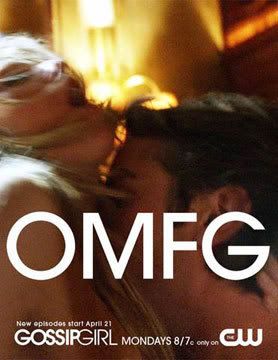
That’s a long, drawn out Oh. My. F@$*&#$g. God.
But what if it’s actually an O-M-F-G?
I really want to know! Especially since even before I came across this poster, I heard “O-M-G” used in a celebrity news report I lost one minute and thirty seconds of my life on last week. Don’t let that time be in vain!
The network airing “Gossip Girl” in the United States has claimed that their ad campaign
speaks directly to our adult 18-34 viewers using expressions that are part of their lexicon.
But would that lexicon be spoken or written? What do you say when you read the thing out loud?
Tell me: is O-M-G just what the anchors on Extra are saying to sound like those kooky MySpace kids? Or is it really appearing in the vernacular? This is one incidence where the recency illusion won’t come into play: I’ll be hornswoggled if OMG has been around one minute longer than AOL.
After two and a half months blogging, I am approaching the all-important 40th post. Today’s is number 39. My nose has been so close to the grindstone, however, that I’ve barely noticed. I’ve got new projects to complete, old bills to write, a daily blog to keep up…in short, I’ve been beavering away.
Have you heard beaver used in this way before? It was new to me when I first heard it at Cambridge.
I’ll let Simon J. James give another example:
One morning last week, I was sitting at my desk, beavering away (building a small dam out of gnawed down pencils)
I found Simon through my BlogRush widget near the bottom of this blog and his extended metaphor was just too adorable to leave out. I also have a sneaking suspicion he’s British, for the following reasons:
- he spells it self aggrandisement and standardise
- he reports a colleague’s utterance of “whilst” in a telephone conversation
- he uses single quotes to explain in an extended riff why his colleague’s use of ‘bye now’ in said conversation was rude
‘Bye now’ suggests immediacy to me, a flagrant disregard for all others in the conversation; it’s the verbal equivalent of hanging up. And also you can’t say, ‘bye earlier’ can you really?
So London Simon (I checked) uses “beavering away.” But what about my U.S. and Canadian readers? Have you used this expression before, or would you call yourself as busy as a bee, instead?
Here’s another explanation from a UK website:
The beaver is remarkable for its industry (and skill) in constructing its habitation and creating dams to preserve its water supply. This gave rise to the verb beaver away for someone who works very hard and to the faintly derogatory eager beaver for a person who is keen to succeed.
The expression is certainly evocative. I wouldn’t dare use it around my American friends, but Simon’s usage is guileless, down to the cute little pencil dam image—or perhaps he’s done that to avoid confusion with that other meaning for beaver:
OK, stop tittering. In British English, to beaver away is to work busily. However, these days you’d have difficulty saying it without a chorus of sniggers from the peanut gallery, as we also all know the American definition. It’s the sort of thing your grandmother might say at Christmas dinner that would make the younger generations choke on their soup.
That one’s from the English-to-American Dictionary. And though apple-pie M-W does define beaver as a verb (dating back to 1946), I think this is one expression best left to the British.